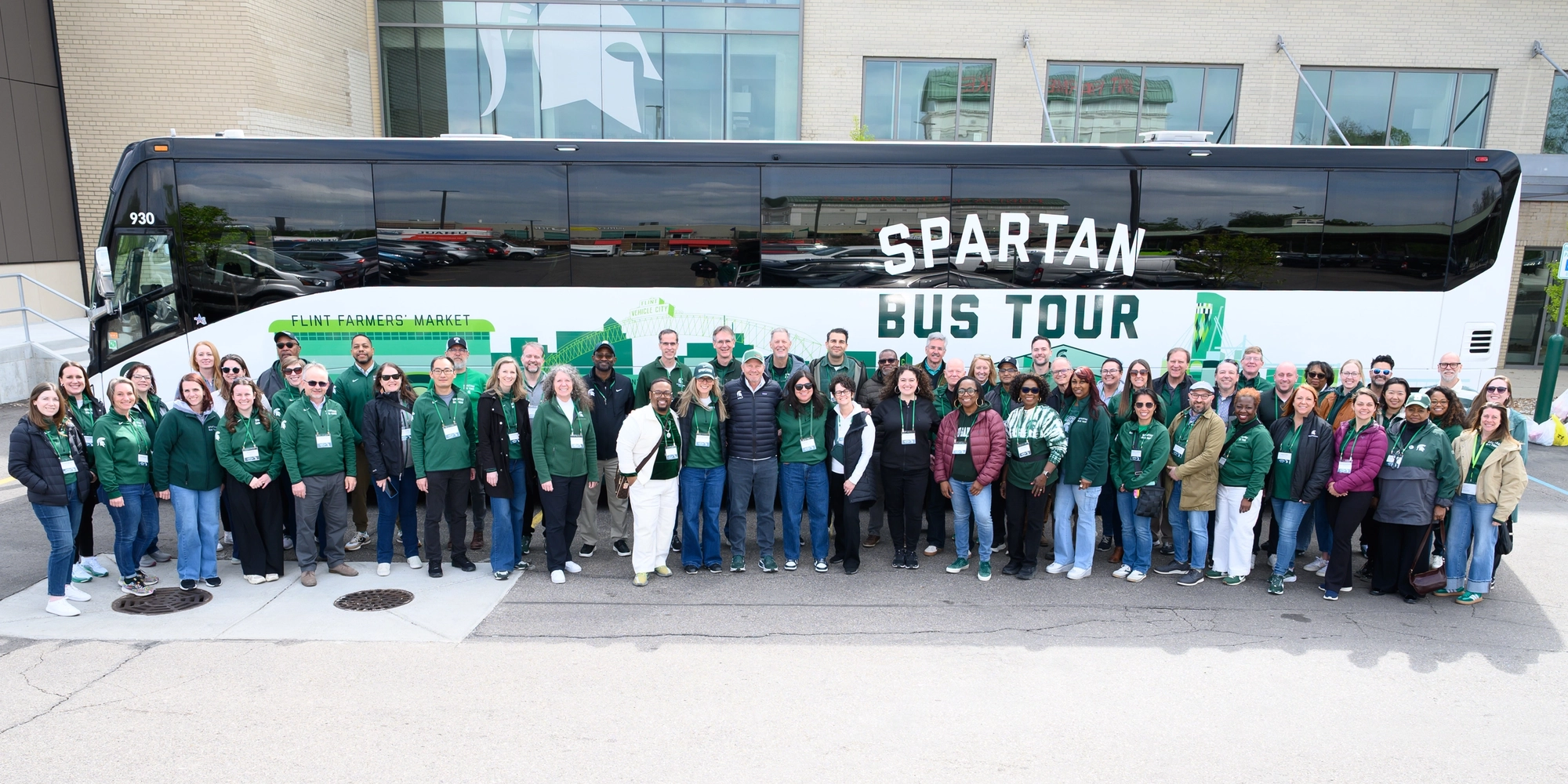
The Spartan Bus Tour allows MSU faculty and administrators to join President Kevin M. Guskiewicz, Ph.D., as they visit locations throughout Michigan to build community connections and strengthen the university’s commitment to education, research, outreach and extension. On May 6-7, 2026, Vice President for Student Affairs James Hintz joined the Spartan Bus Tour, visiting communities in and around Flint, Saginaw and Bay City. Here, he reflects on his experience.
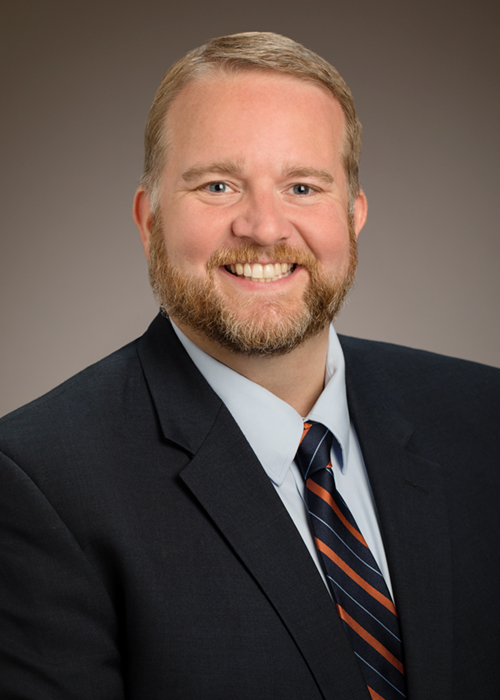
Last week, I had the privilege of joining President Kevin Guskiewicz and a group of MSU faculty and senior administrators for the Spartan Bus Tour's Local Loop through Flint, Saginaw, Frankenmuth and Bay City. Two days, more than a dozen stops, and a powerful reminder of what it means to be a land-grant university.
That distinction matters more than ever right now. At a moment when universities are being asked hard questions about their relevance, their cost, and their relationship to the communities that surround them, the land-grant mission offers a clear and honest answer: We exist to serve the public. Not in the abstract, but in the specific, in the soil, in the clinic, in the classroom down the street. The Spartan Bus Tour is, among other things, a commitment to making that answer visible.
One of the features of the tour is that each participant is paired with a Spartner, a buddy for the trip, someone from a different corner of the university to share the experience with and learn alongside. I was paired with Donna Donovan, associate vice president for Human Resources, and it turned out to be one of the highlights of the two days. Traveling with someone whose work touches the institution in a completely different way than mine prompted conversations I wouldn't have had otherwise. It was a good reminder that the silos in which we operate on campus dissolve quickly when you bring people together.
The tour took us to places that don't always make it into our day-to-day campus conversations. I want to share a few highlights. We visited the Charles Stewart Mott Department of Public Health in Flint, which struck me as a model worth paying close attention to. What makes it remarkable isn't just the research or the outcomes, but how it was built: codeveloped and cogoverned with the Flint community from the very beginning. That philosophy felt deeply familiar to me. It's the same instinct that drives how I think about the work of Student Affairs: not doing things for students but building things with them.
We also visited the Flint Farmers' Market, where MSU-supported programs are literally prescribing fresh produce to kids and teaching families to cook. These are practical, community-rooted interventions that connect research to real lives. A stop at the Saginaw Valley Research and Extension Center showed how MSU's agricultural partnerships reach into the field alongside farmers. Did you know Michigan is the third-largest sugar beet-producing state in the U.S., typically harvesting around 140,000 to 150,000 acres annually, primarily in the Saginaw Valley and the Thumb area?
And then there was Gus.
In Bay City, Donna and I had the honor of participating in a sturgeon release into the local river, part of a 20-year partnership between MSU and the Michigan DNR to protect the species from extinction. Through a naming contest, we got to name one of the sturgeons before sending it on its way for a life that could last over 300 years. One sturgeon was named Gus. President Guskiewicz named the second sturgeon, Sparta. Watching that fish slip into the water was one of those small, quietly memorable moments that captures something larger. Here was a creature that nearly vanished from these waters, now returning because a university and a state agency decided to show up year after year and do the patient, unglamorous work of restoration. That's the land-grant promise made tangible.
These aren't peripheral activities. They are the land-grant mission in action, the direct line between what happens on our campus and what improves everyday life in Michigan. When a child in Flint gets a prescription for fresh vegetables, when a sugar beet farmer in the Thumb region adopts a new practice developed at our extension center, when a species survives because a university decided to show up for two decades, that is what public higher education is for. Telling that story clearly and living it consistently is how we earn the trust of the communities that make our work possible.
What connected all of it, for me, was a sense of the long game. MSU has been showing up in these communities, sometimes quietly and sometimes dramatically, for decades. The students we serve come from places like Flint, Saginaw, Frankenmuth and Bay City. When we understand those places more deeply, we understand our students more fully, and we get better at cocreating experiences and environments that actually meet them where they are. That connection runs directly through our four commitments: helping students belong, engage, thrive and lead. Those aren't just words on a framework. They are shaped, in part, by where our students come from and what they carry with them when they arrive on campus.
I came back to campus energized. The Spartan Bus Tour offers great ideas that serve so many purposes, and I'm grateful to President Guskiewicz for making it a priority. We are, as he reminded us, Michigan's State University, and the road trip is a good way to keep that from becoming just a slogan.