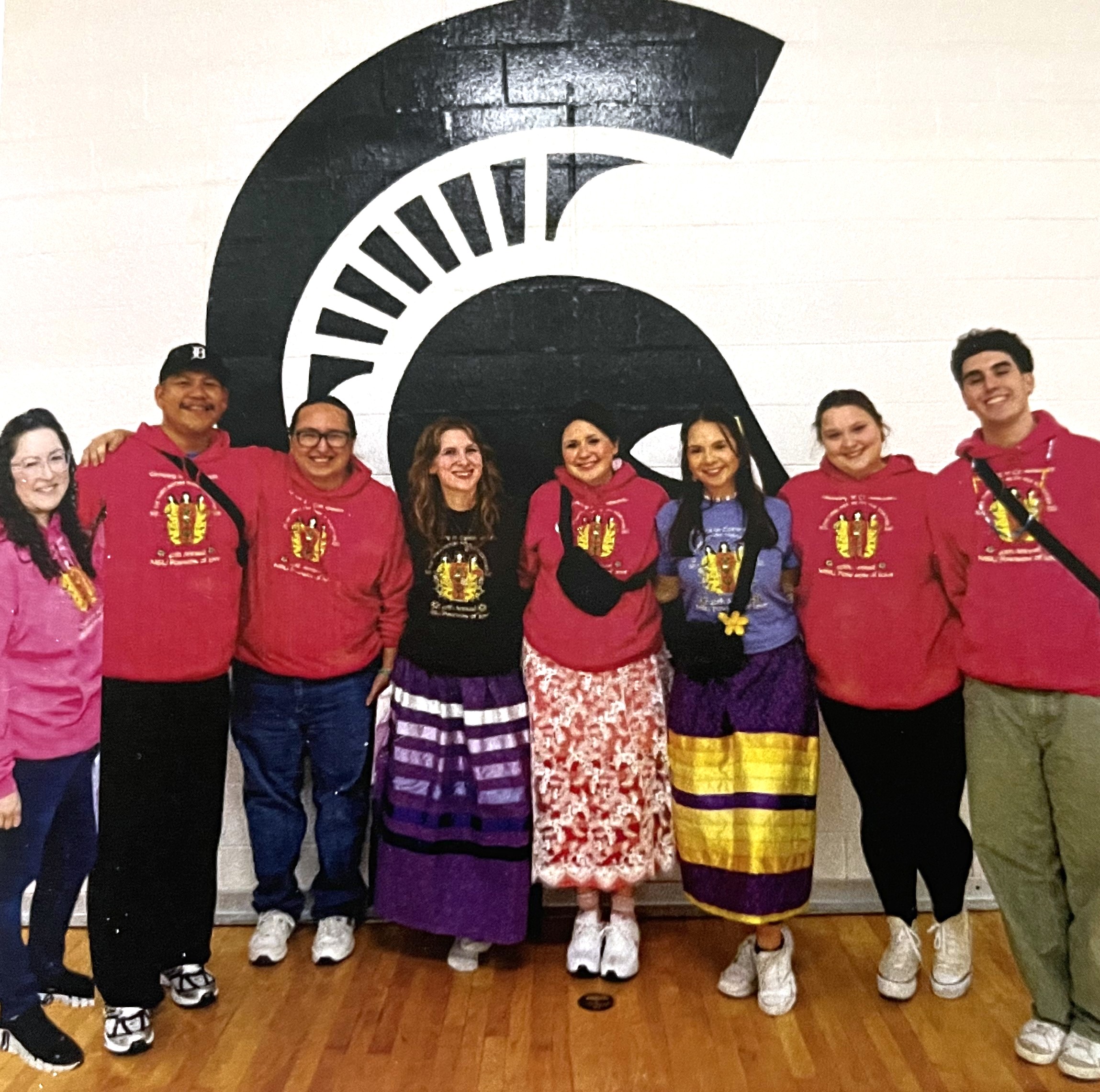
The North American Indigenous Student Organization (NAISO) earned a team award at the Inclusive Excellence Recognition Program, held in April by the Office of Inclusive Excellence and Impact.
NAISO’s Powwow Committee was recognized for producing the 40th Anniversary Powwow of Love event this past February in the IM East building. A typical attendance for the largest student-run event held annually on MSU’s campus reaches around 1,000 attendees. Marking the milestone anniversary, however, the committee set a goal to exceed typical figures, ultimately reaching nearly 2,000.
Animal science/pre-vet senior Carmen Cameron served as Powwow Committee co-chair. She felt both surprised and honored to be recognized.
“We don’t do this because we expect awards or expect acknowledgment, so [the award] felt good. It felt good to feel like we’re seen on such a large campus, as one of the smallest minority groups,” says Cameron. “I didn’t expect it at all. It’s just been an overwhelming feeling of appreciation that I didn’t anticipate.”
The team, who met weekly for months, was honored for their hard work and dedication toward ensuring Indigenous culture is celebrated at MSU. The event is a hallmark event on campus, drawing in students, alums and community members from across the Midwest and Canada.
NAISO Advisor and Coordinator in the Office of Multicultural Enrichment and Advocacy Devon Kuwanquaftewa says he saw first-hand the group’s commitment to the event. He’s proud and happy the committee is being recognized.
“I am truly excited for the Powwow Committee receiving the award. For the past two years, I have joined them on the journey to plan the event. Months of planning, commitment and sacrifice go into planning. Acknowledgment of their dedication to sharing a part of our culture and allowing the greater MSU, Lansing, Michigan, Midwest U.S. and Canadian communities to experience the vibrancy of our communities is a great achievement.”
Cameron says this was her third year co-chairing the event, learning something different each time. The team faces some unprecedented circumstances this year, but ensured the continuation of the historic event.
“There are different challenges for each year, and this year was probably the hardest, with its financial difficulties. I’ve just been so grateful for the help that Pres. Guzkiewicz, Dr. Hines and Dr. Jabbar Bennett have all given us. It’s been awesome.”
Kuwanquaftewa feels this year’s event aligns with the larger message of the event’s history. The team showed persistence and resilience.
“We are resilient. NAISO is a very tradition-driven organization. Some students come with the knowledge and stories of how Indigenous traditions and culture were not always viewed as acceptable,” he explains. “Some students come in with minimal knowledge of the history but learn in the planning process of the event.”
Ultimately, Kuwanquaftewa feels that, whether they started with the knowledge or learned along the way, carrying out the event is done so with the purpose of acknowledging ancestors who fought to keep the Indigenous community visible. Putting on the powwow has become a tradition to pass along the knowledge so the event will continue. This is important, as it also shows the youth who attend there is community and a space for them at a place like MSU.
“I feel like, for many on the board, [winning the award] makes them feel like they want to do more. They want to strive for higher,’ says Cameron. “As a co-chair, that’s all you want. As someone who is going to be graduating, I’m leaving this to my peers. I want them to succeed, and I’m hoping this just makes them want it even more.”