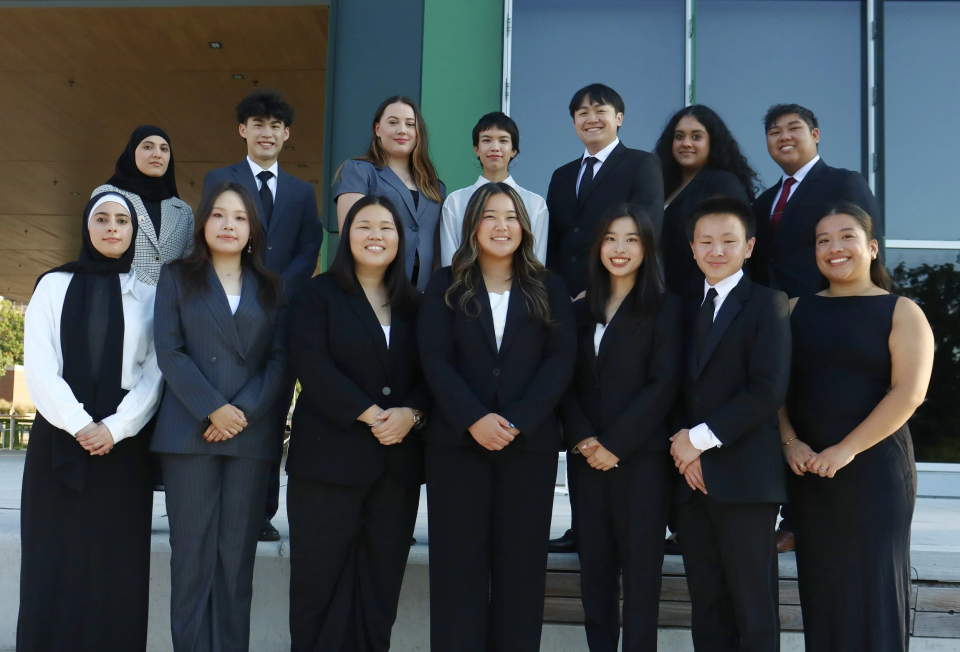
Second-year interdisciplinary social sciences student Tony Pham says he’s always been passionate about being a storyteller. When the Grand Rapids-area native had the opportunity to assist his high school AP World History teacher on a project last spring, he was excited it meant engaging with the Gerald R. Ford Presidential Museum’s effort to highlight 50 years since the end of the Vietnam War.
Pham’s family immigrated to the U.S. from Vietnam in the 1990s. The project inspired him to think about ways to continue to tell his story and that of his broader APIDA/A community. It sparked an idea that became the catalyst for what will be a historic event for MSU. Perhaps most importantly, it’s an event that can potentially shape how Asian Pacific American histories are preserved and represented at the national level, as part of the Smithsonian Institution.
A SMITHSONIAN-SIZED OPPORTUNITY
“I was kind of thinking of a project that could be something that would bring a meaningful moment for, not just Vietnamese students or a specific demographic but hosts an entire population of people,” says Pham.
As the CORES/CAMS liaison for the Asian Pacific American Student Organization (APASO) as well as the Associated Students of Michigan State University (ASMSU) vice president for Academic Affairs, Pham was aware he could potentially put some resources behind a passion project. He recalled hearing about a group being put together to consider the feasibility behind a national museum dedicated to Asian Pacific American history and culture.
Established by Congress in 2022, the National Asian Pacific American Museum Commission is a bipartisan body formally launched in June 2025 to examine the possibility of forming a new Smithsonian museum in Washington, D.C. It would be the first in the Smithsonian collection to honor the Asian Pacific American community. Upon doing more research, Pham learned the commission had just kicked off its national listening tour last fall. Through listening sessions, the commission is working to ensure diverse voices and lived experiences are reflected in how Asian Pacific American histories are told.
“I just thought that was such a cool opportunity and just a cool thing in history, you know? It's not like they're establishing new museums all the time,” Pham points out.
He realized, however, the commission hadn’t yet committed to a stop in Michigan. To him, this felt like an instance where voices beyond the surface were being underrepresented.
“I looked at where they're currently doing their listening tour and they're obviously hitting the places with the big Asian American populations like New York, Texas, California and Florida. When you think of Michigan, you probably don't think of a very large Asian American population,” he says.
According to the State of Michigan, the Asian American and Pacific Islander population has a history that stretches back to the 1800s and now represents one of the fastest-growing demographics in the state, with a nearly 97% growth rate since 2000. Pham is well aware of West Michigan’s role in that increase over the recent decades, with a rich history of immigration from places like Vietnam among other nations. In fact, only three other Midwest cities had more Vietnamese-American residents than Grand Rapids by the 2000 census. He insisted that Michigan’s demographics could and should be a part of the process.
“I kind of felt like that was a missed opportunity and I wanted to be able to share our story, because there are a lot of people here that have their own stories to share. And I wanted to do something that's applicable to the entire state of Michigan. I want the people that live here to have their voices included towards a national project, a historic federal initiative."
He decided to pitch the idea to the APASO executive board as well as the APIDA/A heritage month planning committee: Pham wanted to spearhead an attempt to confirm a listening session for Michigan. APASO advisor and Department Administrator for the MSU Department of Physiology Stephanie Ly was among the group. Also serving on the APIDA/AFSA executive board, she brought the idea to her colleagues to discuss how the group could support. As luck would have it, another executive board member had a direct connection to one of the commissioners.
“Kudos to our students, who are interested in doing something this grand. They’re interested and they're engaged. They want to connect our campus on a national level,” says Ly. “This is the way we support students — we help them connect the dots.”
APASO agreed to the effort, with APIDA Spartans, APIDA/AFSA and the Asian Pacific American (APA) Studies program all offering their support. Pham had a way in.
MAKING HISTORY HAPPEN
It happened fast. Yet it wasn’t easy.
Upon first reaching out in January, the commission was receptive and enthused by the student advocacy. Producing a session in Michigan quickly, though, would be a logistical challenge. A suggestion was even made by a commissioner with ties to the University of Michigan to potentially host the session in Ann Arbor. Pham remained adamant about hosting a session at MSU.
Conversations carried into spring break, during which Pham was able to speak directly to the commission’s Executive Director Krystal Ka‘ai Hetherington. She informed Pham the community’s advocacy would be rewarded — they were willing to host a listening session on MSU’s campus as well as in Ann Arbor.
“We’re so honored to have them consider us and, more, to help us make it happen,” shares Pham. “At that moment, I was just over the moon. I was so excited, and the first thing I did, literally — we have our group chat — was let them know, ‘We did it!’”
They did it, indeed. Somewhat coincidentally, they knew they had an opportunity to host the session during MSU’s celebration of APIDA/A Heritage Month. As for the details, staff and alumni were ready to help APASO work it out in a short amount of time. Pham insists the event could not happen without their support.
Many calls, texts and emails later, they settled on hosting the historic event in a historic venue: the MSU Multicultural Center. The commission representatives will arrive to MSU Saturday, April 11, with the event beginning at 9:30 a.m., and a reception following the listening session. Registration is required. Seeking additional written public input, the commission is also accepting comment submissions.
For APASO leaders, the moment carries both institutional and deeply personal significance.
“My role in this initiative is to help spread awareness among affiliates and within the MSU community,” says Yuqing Wang, vice president of internal affairs. “As the VPIA of APASO, I see the APA Commission as a significant step forward for APIDA/A culture. It allows for greater outreach and representation of APIDA/A communities both at MSU and on a broader scale.”
“We're hitting all of the high schools. We're hitting all of the school districts. We're hitting all of the local communities and areas we think would be interested in contributing their ideas into this discussion,” Pham says.
Wang emphasizes the initiative creates space for voices that have historically been underrepresented. “I believe this initiative will have a powerful impact on the APIDA/A community by amplifying voices that are often underrepresented. It promotes cultural awareness and creates spaces where APIDA/A individuals feel seen, valued, and supported.”
"When people see their cultures and identities being recognized and celebrated, it fosters a stronger sense of belonging and confidence."
- Yuqing Wang, APASO vice president of internal affairs
CREATING AN IMPACT, LEAVING A LEGACY
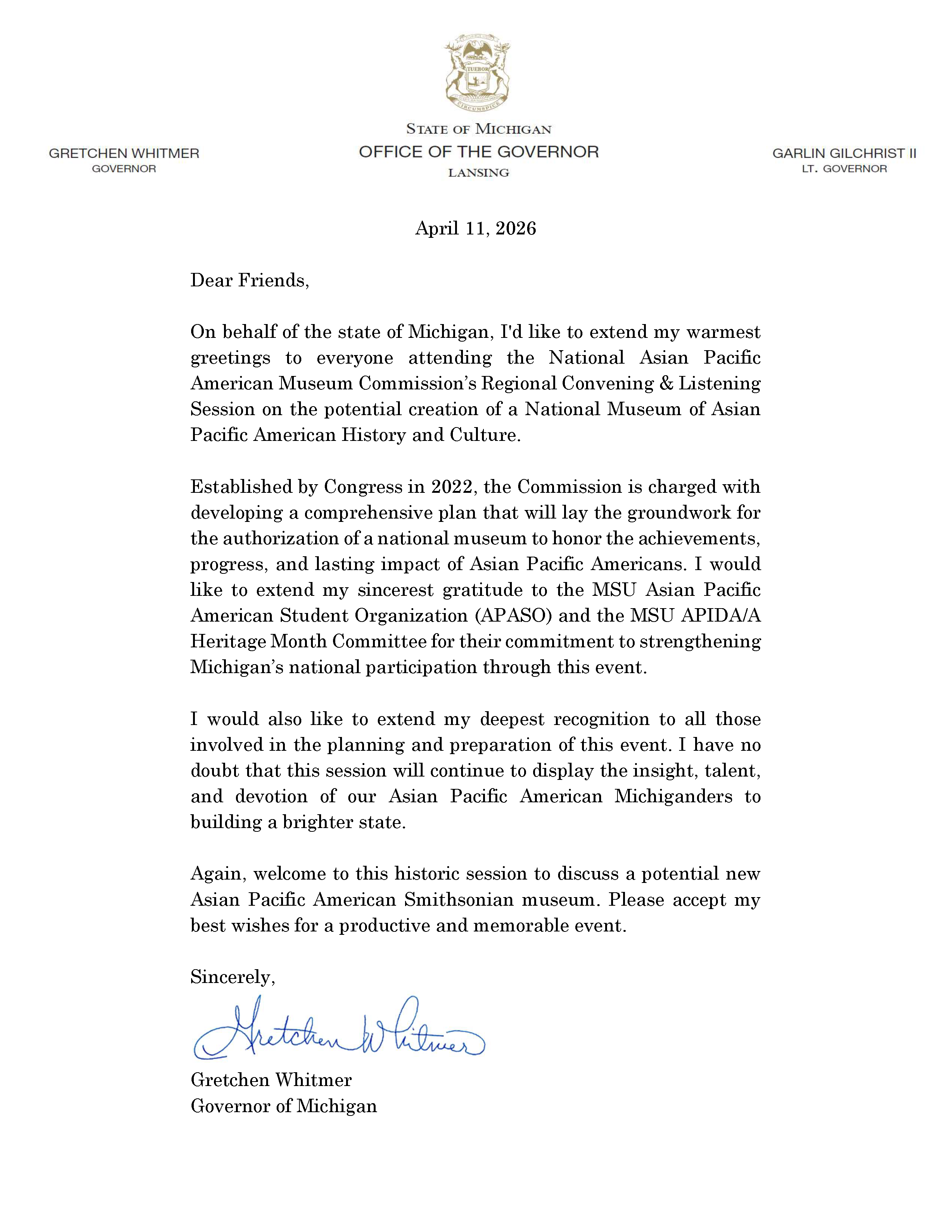 Upon hearing about the momentous occasion, Michigan Governor Gretchen Whitmer has sent APASO a personal letter of support, acknowledging the gravity and significance of the event. In the letter, the governor thanks APASO for their commitment to ensuring the voice of Michiganders is heard and joins APASO in welcoming the commission to the Great Lakes State.
The letter is among several instances leading up to the event that have helped the students truly digest just how significant this event is. The opportunity to contribute to a national conversation is especially meaningful for student leaders like APASO Co-President Maya Fukumori, who sees the event as part of a larger historical milestone.
“This event personally means so much to me as I feel like I am witnessing such a large historical advancement,” Fukumori says. “This would be the first national museum honoring Asian Pacific American history and culture.”
By participating in the commission’s listening session, MSU’s APIDA/A community is helping shape how their stories will be told for generations to come. Beyond the museum, though, the collaboration represents a defining moment in APASO’s legacy at Michigan State.
“This moment is a significant step for APASO’s legacy, as it represents an opportunity to create something lasting and meaningful,” Wang explains. “It highlights the important role APASO plays in advocating for and uplifting the APIDA/A community.”
Fukumori echoes that sentiment, noting the lasting impact of contributing MSU’s voice to a national initiative. “It is surreal to me that we can have a voice in the creation of this museum, as it is going to benefit the past, present and future generations.”
ALSO READ: Maya Fukumori Student View: Reflections on APIDA/A Heritage Month
Beyond policy and representation, community members pointed to something more personal: pride.
“When people see their cultures and identities being recognized and celebrated, it fosters a stronger sense of belonging and confidence,” Wang says.
As the commission continues its national outreach, APASO’s involvement ensures that Michigan State students can forever be part of history.
“This is very exciting to me,” Fukumori says. “I am very proud and happy to see representation in our history, and I believe through hearing new voices across the country, it will help broaden our current understanding and knowledge.”
Along with being an MSU employee, Ly is also an MSU and APASO alum. She also feels a sense of pride in the students’ ability to pull this off. “I see that impact as something alumni across the nation and internationally can be very proud of if this museum comes to fruition. Certainly, in these challenging times where the APIDA/A community continues to be invisible and hate against community is still present, still very much a reality … it should not discourage us. So, as an alum, I'm proud of it. I'm so proud of these students.”
For Pham, the event is already making him think about the future, and he wants those attending the event to think about it as well. He thinks about the possibilities of walking into a national museum, knowing that MSU is part of its legacy. He’s excited about what he may see.
“I want people to leave this event feeling like they got to tell their story. I told [the commission] my family's history, and they listened to ‘Why Michigan?’ — how we ended up here and how others ended up here; how those stories are going to contribute to a national initiative,” Pham says.
“And, you know? I'm hoping one day, whenever I visit D.C., I get to walk in and potentially see an exhibit on the Grand Rapids refugees or other things in Michigan, like maybe an area on Vincent Chin — historical things that have impacted our state because Michigan is home to so many historical moments in Asian American history.”