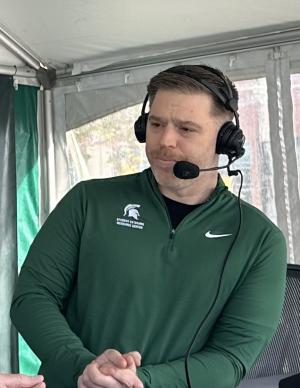
 Patrick Forystek, Veteran and Director of the Center for Veterans and Military-Affiliated Students (CVMAS), discusses how the meaning of the holiday has evolved for him and the campus community.
Memorial Day has existed in some form since the Civil War, with many historians considering the first instance as an 1865 tribute held in Charleston, South Carolina by formerly enslaved people honoring the Union prisoners of war discovered in a mass grave. It wasn’t until 1971 that Congress passed the Uniform Monday Holiday Act and officially established Memorial Day as we have it now, with the holiday always falling on a Monday in May, creating a three-day weekend and a bookend to spring.
I grew up near Flint and only had a few distant relatives who served in the military. Most of my family worked for GM, so I didn’t have a close connection to service others might. Growing up in Michigan without that military connection, Memorial Day meant pool openings and hot dogs on the grill. It signified the start of summer and ushered in the restlessness of those last few weeks of school before summer break. As a kid, my understanding of the true sentiment of Memorial Day wasn’t particularly deep, even if I technically knew what the purpose was.
My service in the Marine Corps changed how I appreciate the holiday. I served from 2008 to 2012 with Bravo Battery, 1st Battalion, 11th Marines, deploying in 2009 with the 13th Marine Expeditionary Unit (13th MEU) and deployed again in 2010 to Helmand Province, Afghanistan. In Afghanistan, I worked as an artillery section chief, leading a team of 13 Marines conducting fire support for NATO forces in the region. In September 2010, we replaced the Royal Marines and supported 3rd Battalion, 5th Marines as they cleared the area of Taliban forces. We worked from Firebase Saenz, a patrol base named after Sergeant Jose Saenz III, “Joey,” who died a few weeks prior on Aug. 9. Joey originally did not deploy with us but was sent as a combat replacement due to earlier losses. From September to January, the Marine Corps would lose over 25 Marines and had 184 wounded from fighting in and around Sangin.
Memorial Day certainly meant something different after that. Those feelings from my childhood still existed. It’s still cookouts, pools, and visiting friends and family, but there is a somberness that permeates the weekend. My mind will often drift to friends who died and what it would be like to have them back for a day. My wife is a therapist and seemingly always has the perfect piece of life advice. “Dialectics,” she tells me. Two opposing truths can be true at once. It’s okay to appreciate Memorial Day for what it represents, taking a moment or two to stop and think about sacrifice, but still enjoy time with friends and family.
Here at Michigan State, we have a deep and storied military history. The first graduating class in 1861 had seven students. The entirety of that class would leave before completing their final exams and two, Gilbert Dickey (1863) and Henry Benham (1864), would not survive the war. They are memorialized on a plaque on the first floor of the MSU Union, along with 13 other students from the classes of 1861–64 who would die in the war.
As a Spartan community, we remember them and others who have died in service to their country throughout different spaces on campus. At the Grove of the Great War near Williams Hall, we remember Spartans who perished in WWI at places like Belleau Wood, Chateau Theirry and Marne. At the MSU Alumni Chapel, we see the names of 487 students who died in the line of duty across all conflicts. At the MSU Union, which was originally dedicated as the MSU Memorial Union in honor of the MAC students who gave the ultimate sacrifice, we see plaques on the first floor and outside the west entrance calling attention to their names and their sacrifice. Near Cowles House, just to the east, there is a single tree dedicated to an Army corporal and artilleryman named Cosmer Leveaux, who was a corporal with Battery A of the 119th Field Artillery, a unit still here in Lansing today just down Michigan avenue, near Lansing Eastern High School.
Our memorials exist in spaces where we gather to celebrate what it means to be a Spartan. These are places we walk by every day, running between meetings, often without noticing. Memorial Day is a time to notice and a time to tell the stories of our friends and family who gave their all.
It’s the stories that keep them alive in our memories. Tim O’Brien is an author who served in Vietnam and wrote “The Things They Carried,” among other popular works.
There’s a line from that book that sticks with me and reminds me of Memorial Day and the importance of remembering:
“The thing about a story is that you dream it as you tell it, hoping that others might then dream along with you, and in this way memory and imagination and language combine to make spirits in the head. There is the illusion of aliveness.”
Maybe that’s what Memorial Day asks of us more than anything else. We don’t seek grand gestures, but remembrance. To pause in the middle of the noise and celebration of kids playing in the yard and dogs trying to steal some snacks from an unwatched table long enough to think about the people behind the names etched into plaques, stones and memorials across our campus and communities. To tell their stories. In doing so, even briefly, we allow them to live again in the places they once walked beside us.
*Banner photo by Aaron Burden