By Francisco Velazquez
Following the opening of Michigan State University’s Multicultural Center (MCC) in February 2025, a new stone sculpture was unveiled in August 2026 in the space to kick off the new academic year.
The Public Art on Campus Initiative Committee, guided by the Coalition of Racial Ethnic Minorities (COREM), MCC Steering Committee students, and key stakeholders, commissioned Anishinaabe artist stone sculptor Jason Quigno of the Saginaw Chippewa Tribe to create the piece. The goal was to find a Michigan- or Great Lakes region-based artist, so the choice was intentional.
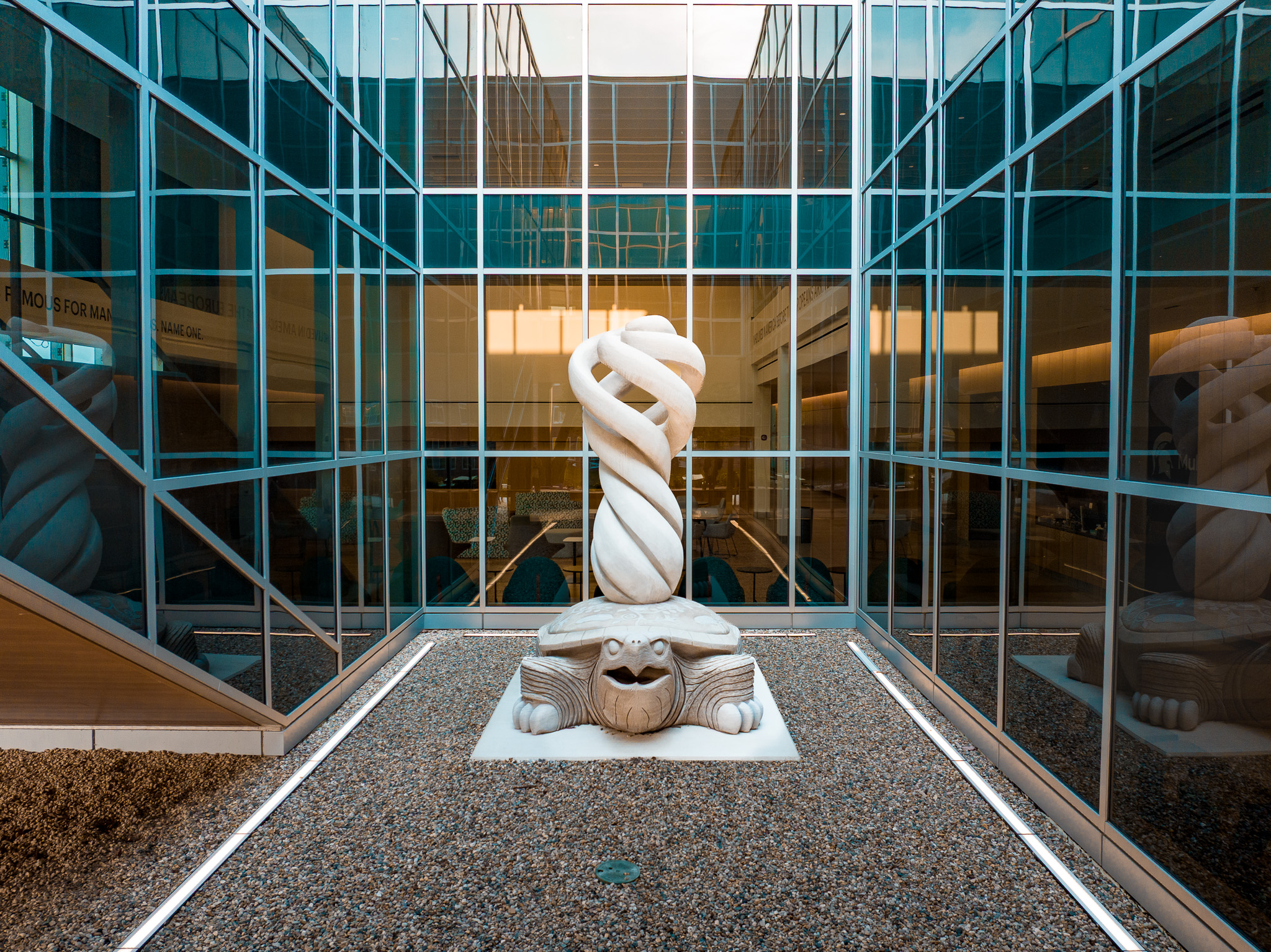
Through thoughtful dialogue with the steering committee, student organizations, the Native American Institute, and university partners, Quigno designed a soaring, 14.5-foot monument that seamlessly bridges both traditional and contemporary stone carving to honor some important themes.
Designed to reflect both the decades of student advocacy for a free-standing facility as well as the vibrant multiculturalism of the Spartan student body, the sculpture celebrates the strength of diverse groups coming together. It took over a year to create and serves as a nod to the advocacy of the initial Council of Racial and Ethnic Students (CORES) groups—the Asian Pacific American Student Organization (APASO), Black Students’ Alliance (BSA), Culturas de las Razas Unidas (CRU), and North American Indigenous Student Organization (NAISO).
The vision for the center stretches back to the Civil Rights Movement and became a core mission for CORES groups as they were founded over the decades. Advocacy for a freestanding building gained momentum over time and expanded to organizations within Fraternity and Sorority Life as well as what is now the Council for Marginalized Students (CAMS).
As Quigno notes, the piece serves as a reminder of collective unity: “[The sculpture] represents how when we all come together, how beautiful things can be. If we really stop and take a look at each other, each other's differences of culture, embrace it... the better society is.”
Computer Science senior and NAISO co-chair, Margaret Broderick, says she loves the sculpture: “The placement of the piece at the entryway of such a central part of campus and the tying in of CORES organizations within it shows how essential our voices have been to both the creation of the MCC and campus culture as a whole."
Sociology junior and current Culturas De Las Razas Unidas co-chair, Rafael Gordillo Serrano, agrees and believes that one cannot talk in-depth about the MSU Multicultural Center without acknowledging the collective work of CORES and subsequent groups in establishing the building.
“It's a subtle reminder to campus that student leadership is not only vital, but transformative,” Gordillo said. “It'll leave a lasting impression to generations of future leaders to show the work that's been done so far.”
Carved from a 20,000-pound block of stone, the installation blends traditional and contemporary Anishinaabe storytelling:
The Turtle Base: Represents the land, the Anishinaabe people, and one of the chief clans, anchoring the sculpture in traditional heritage.
The Floral and Cyclone Motifs: Features carved floral designs on the shell and a hollowed-out, dynamic whirlwind rising upward.
Four Intertwining Directions: Four connected stone bands swirl upward into a single form, symbolizing the intertwining of cultures, the four cardinal directions, and the four initial CORES student groups whose decades of activism made the center possible.
A Lasting Legacy for Future Generations
Rooted in the Anishinaabe belief in blood memory—that knowledge and traditions are passed down through generations—Quigno intended for the monument to offer comfort and representation to Indigenous and marginalized students. By embedding cultural stories into permanent stone, the piece acts as both a quiet space for current students to reflect and a footprint for the “next seven generations.”
Office of Multicultural Enrichment and Advocacy/Multicultural Center director, Samuel Saldivar, agrees the sculpture aligns well with the intentionality of the building. He’s glad to see a piece that openly celebrates the unifying of different cultures under the Spartan flag.
“It fits in well with the space and, as someone who knows the importance of storytelling, this is something that will help students continue the dialogue,” Saldivar said. “As alumni, they’ll be able to come back and share stories with their kids, share the symbolism of the sculpture. It’s those connections in reaction to the sculpture that makes this art so meaningful.”
A Building "By the Students, For the Students"
The installation of the sculpture marks the culmination of a building process rooted entirely in student voice. Conceived after more than 50 years of student activism and shaped directly by over 60 student ambassadors, every inch of the Multicultural Center reflects student needs. From participating in design interviews to testing room furniture and selecting art, students ensured the facility would serve as a true sanctuary.
Saldivar shares that the unveiling of the sculpture kicks off a set of initiatives in the coming months to incorporate more art and representation in the building. The Board of Trustees directed as part of the Public Art on Campus Initiative that half a percent of project costs for new capital projects be designated towards public art. The sculpture was funded with this piece of the budget and more will continue to fund art that helps represent the student body. One of the intentions is to produce rotating and residency opportunities for students and other community members.
For now, the sculpture now stands as a focal point inside the 34,000-square-foot facility, serving as a snapshot of this moment in MSU’s history and a testament to what student advocacy can build.
For Broderick, the impact is indeed meaningful.
“It is a beautifully done art piece, and its message only adds to [it’s impact]. Having a piece of Indigenous-made art, to me, emphasizes the fact that Indigenous people are still here both at MSU and on Turtle Island as a whole.”